Welcome to today’s issue of Other Life. If you received this from a friend, subscribe here. If you love the newsletter, become a member!
One quick thing:
The next cohort of our group writing accelerator is starting soon (Monday, Sept. 11). Many of our people swear these cohorts will increase your focus, improve the quality of your thinking, and increase your writing output substantially—in a friendly and inspiring community of independent scholars. If you’re on the fence, book a short call with me and I’ll help you decide whether you’d be a good fit. If you’re ready, enroll now (seats are filling up).
After Rome fell in 410, everyone was looking for someone to blame.
Many people pointed fingers at the Roman adoption of Christianity as the cause of Rome’s downfall.
In response, Augustine embarked on an epic, decade-long quest: first, to dismantle the absurdities of Rome’s pagan polytheism, and then to explain why the Christian revelation provides the most solid foundation possible for human flourishing.
Augustine’s method was not primarily to use scripture as an authority, but rather to use logic, psychology, and an intuitive, proto-scientific sociology to explain the underlying rationality of the past, present, and future.
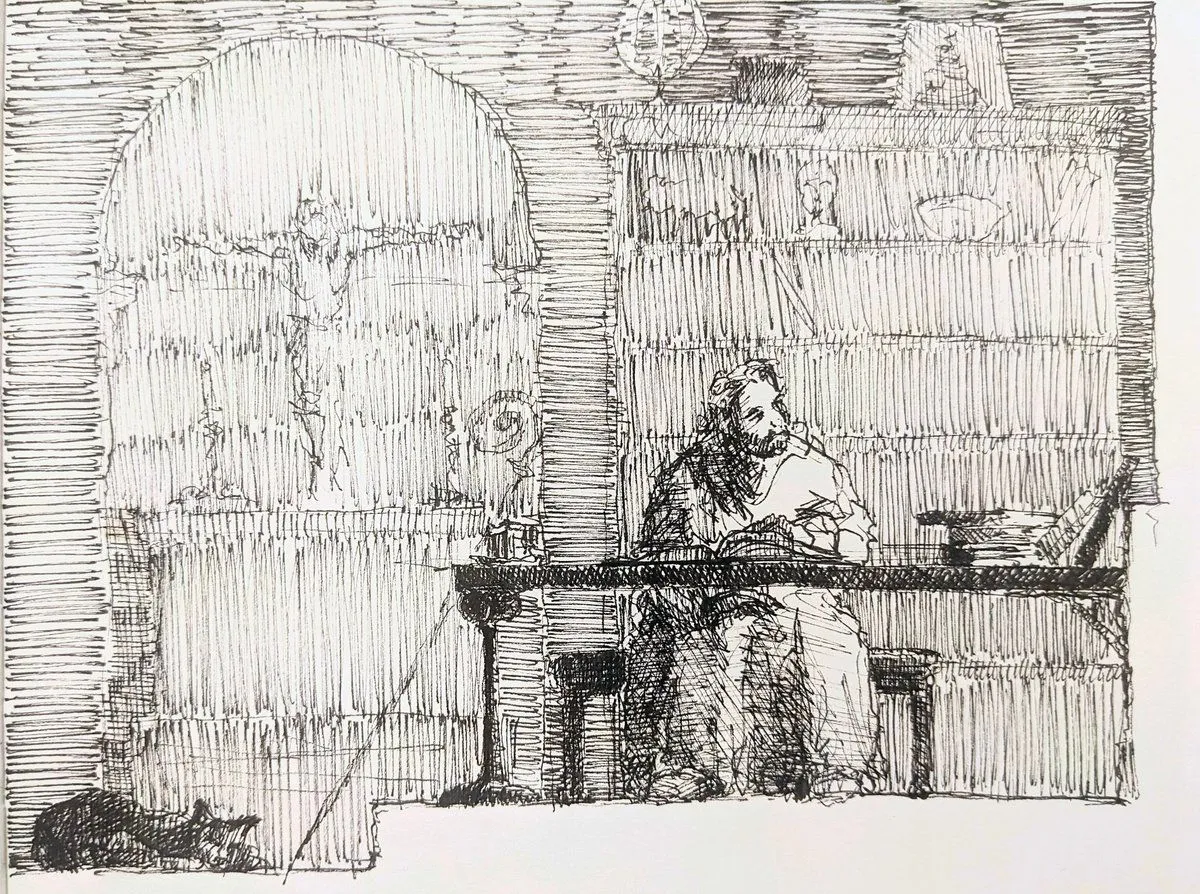
St. Augustine in His Study, After Carpaccio by J. Elliot
The result was his magnum opus The City of God, spanning a monumental 22 books written over 13 years from 413-427 AD. Books 1-10 refute the pagan critique of Christianity, while 11-22 unfold Augustine’s sweeping vision of history centered on the two cities.
The two cities are not different places, but two trajectories for sets of people—the earthly city founded by love of self, and the City of God founded by love of God. Their starkly different paths are not just theological speculation, but observable through history.
Remember that modern science is possible because of the never-tested and never-evidenced assumption that history is rationally intelligible. Science certainly “works,” yes, but it’s ability to produce results is only a pleasant surprise, philosophically underdetermined, based on the pre-scientific collective faith that history happens to possess some kind of underlying order and structure.
Where do you think that faith came from?
It seems to have come, in no small part, from St. Augustine.
The City of God is Christianity making the first glimmers of science possible.
“We need prophetic figures to be able to identify and properly know present reality, not only past and future reality. We have to know what is true community, what community therefore has a future, and what does not.” John C. Cavadini, The Cambridge Companion to The City of God
The City of God feels alien and boring at first, but that’s only because Augustine’s goals are so grand that it’s almost impossible for us to appreciate them. When we grasp the larger vision of his project, all the seemingly obscure analyses start to feel more exciting and inspiring.
One of the most bizarre things for contemporary readers, in the first half, is that he takes seriously the idea that adopting the true religion brings good outcomes whereas adopting a false religion brings bad outcomes.
As mentioned above, it was a common critique of Christianity that its adoption by the Romans brought bad results. So Augustine sits down and collects dozens of mini case-studies analyzing precisely the cause-and-effect dynamics in the variations and vicissitudes of Roman religion.
Felicitas wasn’t adopted until this year but funny that, the Romans had all of their greatest luck before then… This is hundreds of years before scientific method was invented, mind you, but he’s essentially attempting to do it.
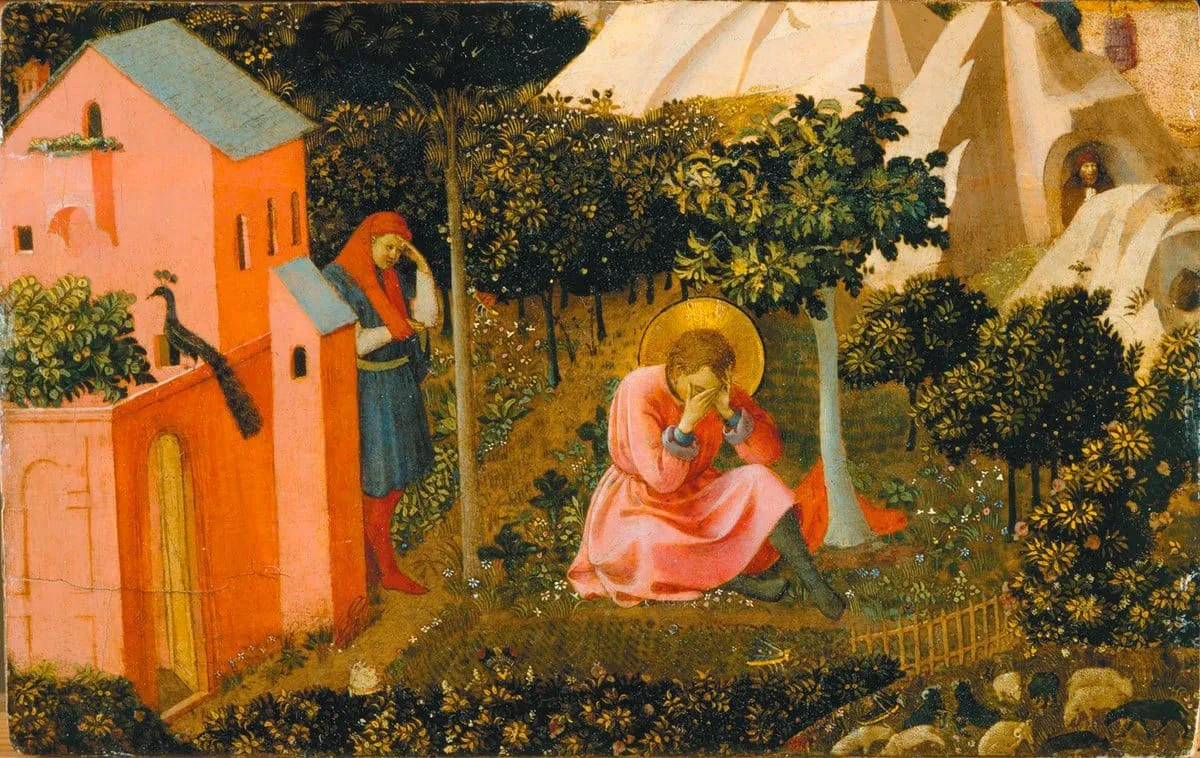
The Conversion of St. Augustine (1430) by Fra Angelico
Today if you say that adopting the true religion tends to bring good outcomes you are pilloried; by the atheists, who think that’s superstitious, but also by Christians, who will say that’s materialistic utilitarian “prosperity gospel” nonsense. But apparently none of these Christians has read Augustine closely, because he takes for granted that the adoption of the true religion brings good outcomes, relative to what we’d expect in the absence of its adoption, and that this can be demonstrated with a kind of proto-scientific method.
When we appreciate this daring gambit, every arcane subsection can now be understood as just one step in a rather exhilarating drama.
“The [City of Man] is largely visible, while the [The City of God] labors most often secretly in the hearts and minds of those intent on truth.” David Vincent Maconi, The Cambridge Companion to The City of God
You should read a book like this with an ear toward the larger drama; don’t worry if one sentence about Jupiter or another sentence about Cicero is lost on you. Just keep reading, then read about Jupiter or Cicero later (as your interests dictate).
We’re meeting to discuss the first half of The City of God (Books I-XII) this Saturday at 11am Central.
I’m reading the Modern Library version but I don’t care which you choose.
As always, seminars are graduate-style, which means I’ll provide some brief remarks to begin but participants are expected to do the reading and bring questions, comments, and ideas (ideally written in advance).