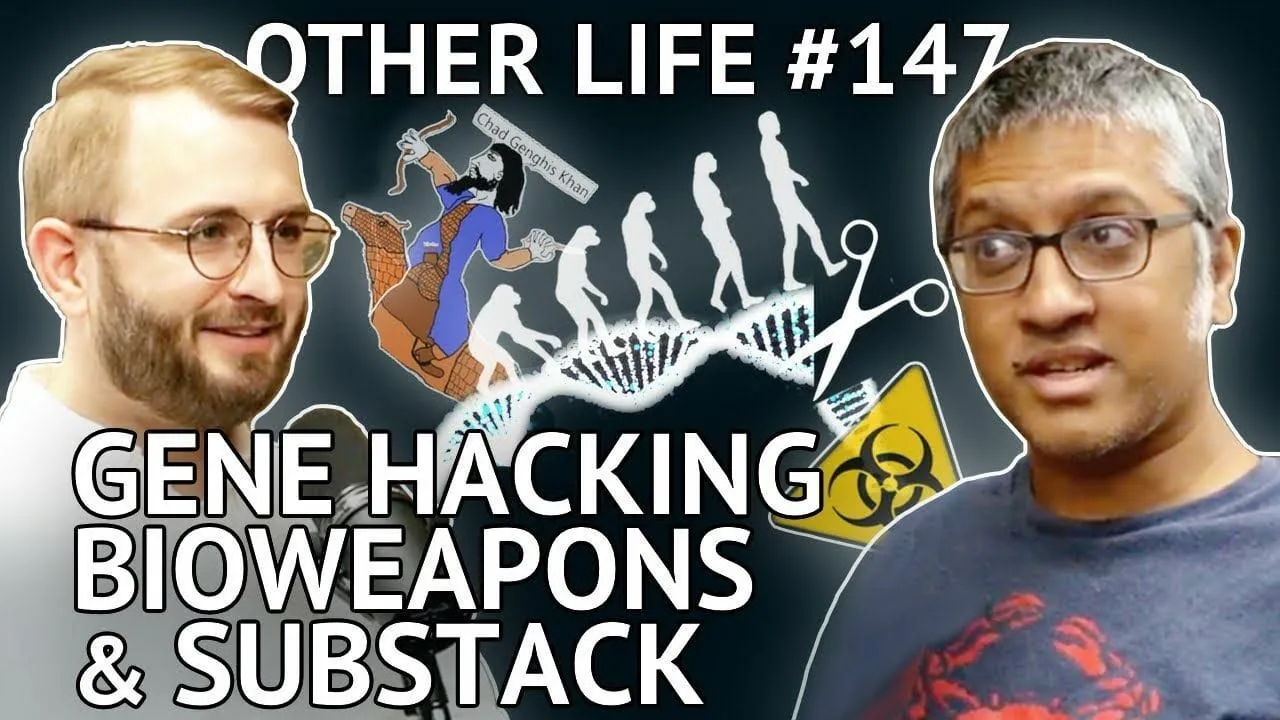
Other Life #147 with Razib Khan
I just published a new episode of the podcast. Highlights below for your reading convenience. Highly recommend this one**,** some true galaxy brain content here.
Razib Khan writes the #1 Substack in the Science category. We talk about how to genotype your unborn baby, whether we can increase our intelligence and testosterone with CRISPR, whether Genghis Khan was good actually, how Razib is succeeding on Substack, and much more.
If you’re not already subscribed to the podcast, please take a second to subscribe on Apple Podcasts, Google Podcasts, or Spotify.
On being in the Kali Yuga and when the woke get their hands on CRISPR
Razib Khan: I think we’re in the Kali Yuga. I think people are inverting normality. And I don’t think that’s sustainable. I think human nature is what it is. And it will ultimately come back to that into some sort of stable state.
There’s only certain ways you can organize society.
Let’s say polyamory. Okay. We have mutual friends who are into that sort of stuff.
This has been tried multiple times in United States history. It always peters out as a cultural phenomenon. I’m not saying that it goes extinct, but as a lifestyle choice and a cultural phenomenon, it always peters out, ‘cause guess what?
Most people can’t do this, and so this idea that everyone should experiment with their sexuality… No, you know, I’m Gen X. I can tell you, some people are born gay. They’re born that way. I think it was like an injustice that when they were young, they were demanded to make sure that they were, like it wasn’t natural for them.
That’s not what they wanted to do. And so that’s why we, as a generation decided, they get to do their own thing. Let them be who they are.
Now, the pendulum has swung in a weird way where a lot of people are like you should experiment with your gender identity and your sexuality.
And I’m like, “You should!”
“But don’t talk to me.”
Justin Murphy: Just wait until those people get CRISPR.
Razib Khan: Yeah. Which is true. But that’s at least concrete, like if you wanna be a catman, CRISPR that up!
Justin Murphy: Yeah, [laughs] yeah.
Razib Khan: Like, more power to you. That’s your choice. My only point is I think that people are trying to push a level of flexibility and openness on the typical American, typical human, where it’s… No, we’re, most of us are pretty much template people.
There’s a template, we age, we marry, we have children, it’s like in the Indian system, you’re a young man, you’re a householder, and then you retire and you go into the forest to contemplate, stuff like that.
On antinatalism and welcoming our Amish overlords
Razib Khan: Antinatalism has a short shelf life. By definition, tautologically, it can’t become dominant and last for very long. Eventually the minority of people that want children will just inherit the earth ‘cause they’re the only ones who have children. Now, you could have a situation where their children are converted every generation in some sort of equilibrium state. I think that’s what we’re seeing, religious people have had more children than nonreligious people for at least 200 years probably, but America’s getting more and more secular because they’re being converted.
You can have an equilibrium culturally but I do think that our current age’s fixation on individual self-actual- actualization, hedonism, and just living for the now, I think that has a short shelf life. Look at the doubling time of the Amish, there’s gonna be more than a million Amish, I think, by the end of the century.
Justin Murphy: So basically what you’re saying is that this is a non-issue because the atheist careerist types who don’t wanna have kids are just gonna exit the gene pool.
Razib Khan: Don’t hate on atheist careerists too much [laughs].
Justin Murphy: [laughs]
Razib Khan: I saw something in The New York Times or somewhere where it was basically like, “don’t have children. I had children when I was young and it was a horrible decision. You should just go travel and experience the world.” And to be judgmental I was just like, god, you’re such a hedonistic, pathetic human being. I’m just like, okay, I’ve traveled the world. It’s fine.
Justin Murphy: I was just gonna say, you can travel the world when you’re in your 20s and then also have a family [laughs].
Razib Khan: I just don’t get this whole idea. It’s “gotta smell the mountains on the other side of the world as well as the mountains…” I’m just saying: Children versus another building? I think buildings are great. I think architecture’s great. I think nature is great, and different types of nature and architecture are great, but there’s something wrong in your value system when children are just not as exciting.
And I’m fine with people saying they don’t wanna have children. Just don’t have children. I don’t wanna hear about it anymore.
On the myths that ancient DNA will debunk and why gym bros are swarthy
Justin Murphy: What are the myths that you think people currently believe that will be disproven by ancient DNA?
Razib Khan: One thing that has been disproven by ancient DNA is continuity. So the idea was, humans spread out of Africa, they just settled, and everyone’s descended from the first people there.
It turns out there’s been multiple turnovers almost everywhere. So the first settlers often don’t last, they don’t stick. People get replaced. There’s migration. There’s replacement, there’s competition. So that’s definitely been a new revolution.
I think one myth in terms of people, what they think is, there’s been a lot of phenotypic evolution and we can infer it. We can look at the genome and make a statistical calculation. But it’s different when you can concretely see it.
So I can tell you that I saw some RNH samples from Estonia. And something like 70 percent of the alleles of the genetic variants for eye color were for blue eyes. Today it’s 95%. So that’s 2,500 years. There was no overall genome-wide change. There was no population moving in.
Justin Murphy: So what does that mean?
Razib Khan: That means there was natural selection.
Justin Murphy: Does that mean that humans prefer blue eyes, and so…
Razib Khan: People of northeast Europe have way more blue eyes than they did 2,000 years ago.
Justin Murphy: But I’m saying what do you think is the mechanism?
Razib Khan: We don’t know.
Justin Murphy: You think people are more likely to abort brown-eyed kids or something like that?
Razib Khan: I think people today are, but we don’t really know. People in the past, they had different preferences because they were on the Malthusian margin, right? I think it’s not implausible that, because pigmentation pathways are hooked into a lot of… So if you take testosterone, you’re gonna get darker.
Justin Murphy: Like darker skin?
Razib Khan: Yeah. Because what happens with testosterone…
It upregulates your melanocortin. So if you look at a lot of these gym bros, you start noticing they’re a little like swarthy.
Justin Murphy: Fascinating. I always assumed that was tanning.
Razib Khan: But yeah, when men hit puberty, they get darker. After women hit menopause, they get darker ‘cause their testosterone to estrogen ratio shifts. So estrogen tends to make you paler. Testosterone makes you darker.
And that’s just a side effect of the fact that all these hormonal pathways are mixed in together.
Justin Murphy: Fascinating. Watchers of the show will know that if I start looking like a brown guy… It’s ‘cause I’m jacked up on testosterone. [laughs].
Razib Khan: I think they will maybe notice because of the thickness of the neck first, right?
If you’re not already subscribed to the podcast, please take a second to subscribe on Apple Podcasts, Google Podcasts, or Spotify.